

















2025.07.27
想要守护能量好状态?快稳住“肌”础牌!




纽崔莱
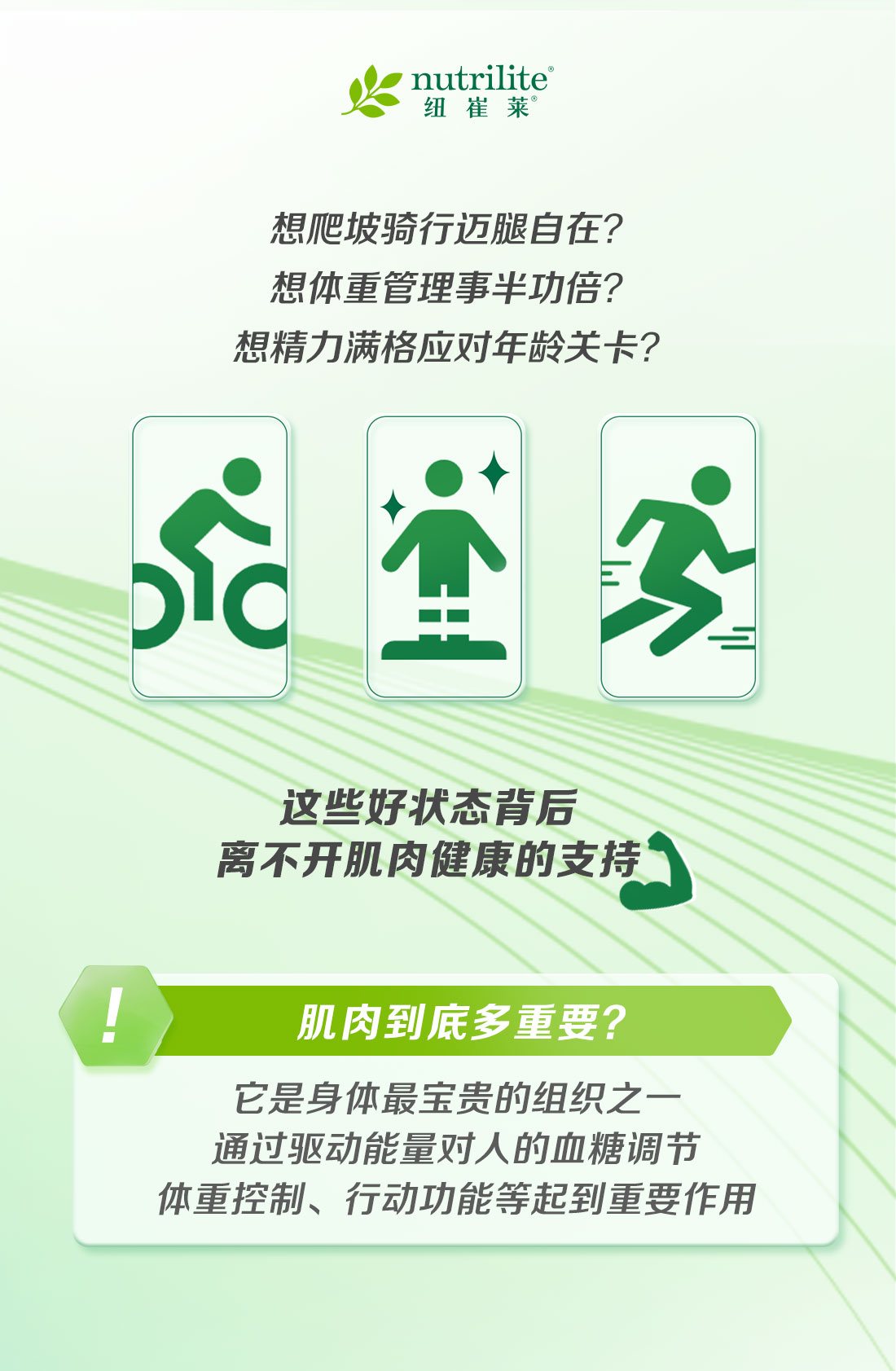
想爬坡骑行迈腿自在?
想体重管理事半功倍?
想精力满格应对年龄关卡?
这些好状态背后
离不开肌肉健康的支持
肌肉到底多重要?
它是身体最宝贵的组织之一
通过驱动能量对人的血糖调节
体重控制、行动功能等起到重要作用
因此,要保持健康活力
先打好「肌」础牌!
激活全身能量态
肌肉就是你的健康底牌
1 "肌"础牌
肌肉中存储大量糖原¹
为身体供应能量
一定肌肉量可延缓身体机能退化¹
肌肉储备能量
充沛精力有底气
肌肉量足了疲惫感少了
对抗体能衰退更自信
2“肌”础牌
增强肌肉可提高能量代谢率²
有助于调节胰岛素分泌³
血糖稳了,有助减少饥饿感³
更易控制体重
肌肉调控代谢
体重管理更轻松
不担心体重秤数字波动
健康水平更易达标
3“肌”础牌
肌肉释放能量以收缩发力
同时包裹关节缓解冲击
从而完成正常行动
肌肉呵护关节
行动稳健更自在
给足骨骼关节安全感
走跑跳稳了活动更自在
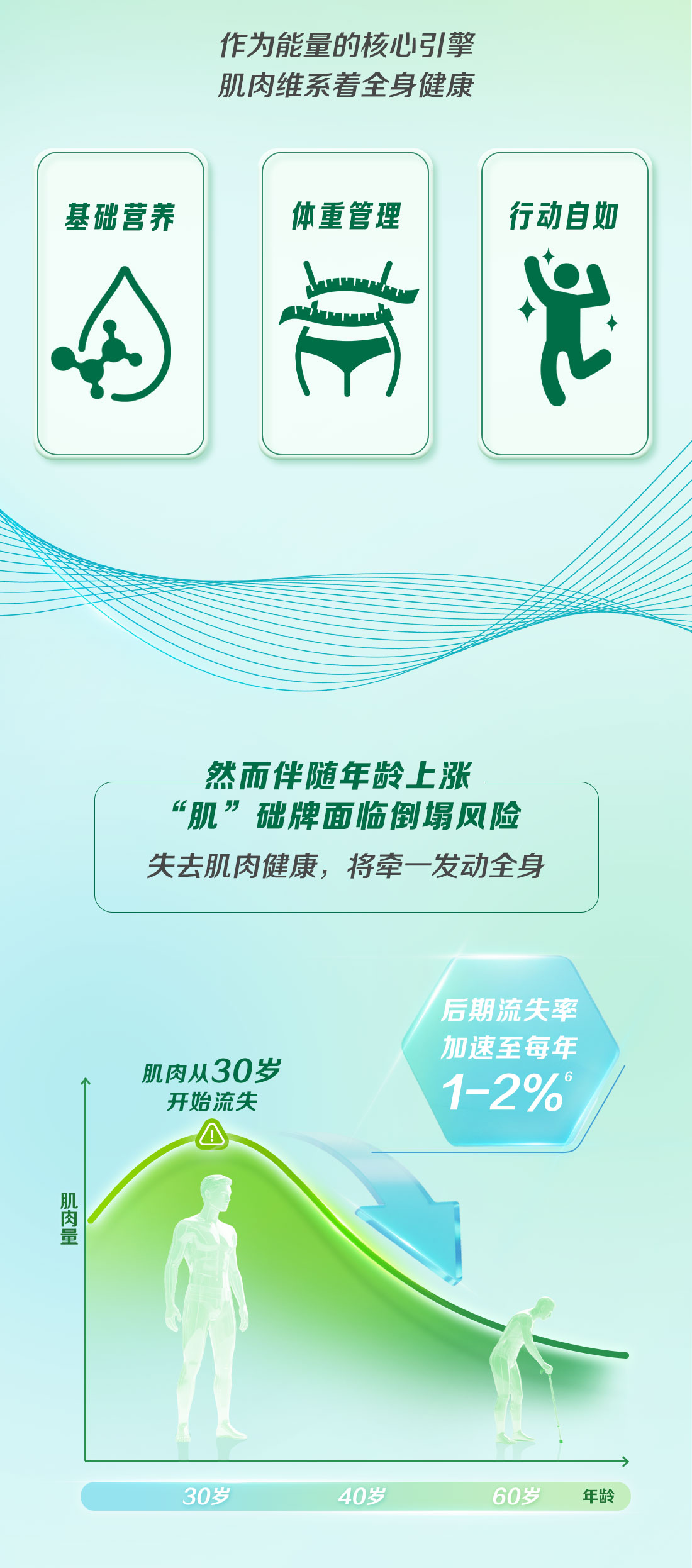
作为能量的核心引擎
肌肉维系着全身健康
基础营养
体重管理
行动自如
然而伴随年龄上涨
“肌”础牌面临倒塌风险
失去肌肉健康,将牵一发动全身
肌肉从30岁
开始流失
后期流失率
加速至每年
1-2%
肌肉量
30岁
40岁
60岁
年龄
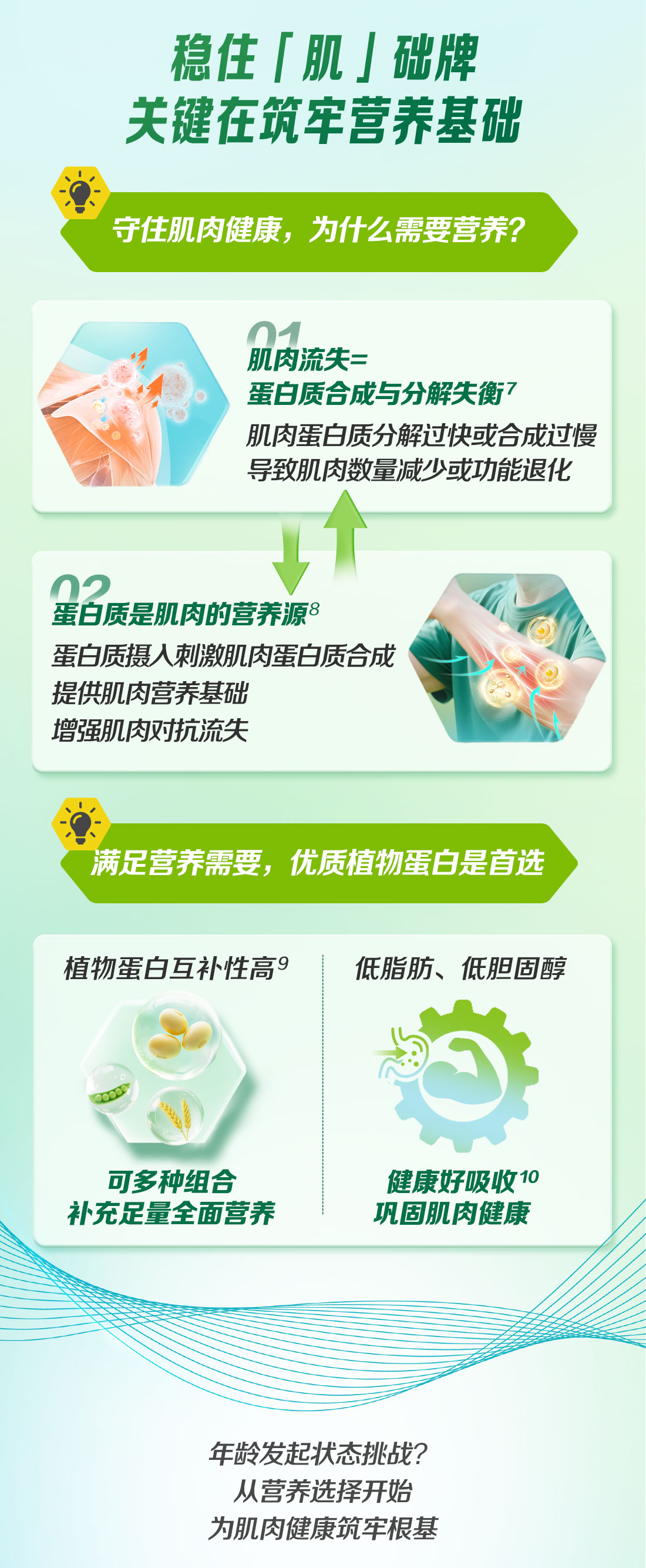
稳住「肌」础牌
关键在筑牢营养基础
守住肌肉健康,为什么需要营养?
01 肌肉流失=
蛋白质合成与分解失衡
肌肉蛋白质分解过快或合成过慢
导致肌肉数量减少或功能退化
02 蛋白质是肌肉的营养源
蛋白质摄入刺激肌肉蛋白质合成
提供肌肉营养基础
增强肌肉对抗流失
满足营养需要,优质植物蛋白是首选
植物蛋白互补性高
可多种组合
补充足量全面营养
低脂肪、低胆固醇
健康好吸收
巩固肌肉健康
年龄发起状态挑战?
从营养选择开始
为肌肉健康筑牢根基
下期详细揭秘
神秘成分加持让肌肉更强健
为健康底牌持续加码
打好健康「肌」础牌
一起守护能量好状态
科普知识内容,仅供消费者参考,不构成任何医疗建议
科学文献参考来源:
[1]Gustafsson, T., & Ulfhake, B. (2024). Aging Skeletal Muscles: What Are the Mechanisms of
Age - Related Loss of Strength and Muscle Mass, and Can We Impede Its Development and
Progression? International Journal of Molecular Sciences, 25, 10932.
[2]Vigelsø, A., Prats, C., Ploug, T., Dela, F., & Helge, J. W. (2016). Higher muscle content of perili-
pin 5 and endothelial lipase protein in trained than untrained middle-aged men. Physiol.
Res., 65, 293-301.
[3]McPherron, A. C., Guo, T., Bond, N. D., & Gavrilova, O. (2013). Increasing muscle mass to im-
prove metabolism. Adipocyte, 2(2), 92-97.
[4]Al-Zuheri, A., Luong, L., & Xing, K. (2012). Biomechanical Assessment of Lower Limbs Using
Support Moment Measure at Walking Worker Assembly Lines. In Ergonomics - A Systems Ap-
proach (pp. 17-38). InTech, ISBN 978-953-51-0601-1.
[5]Sarvazyan, A., Rudenko, O., Aglyamov, S., & Emelianov, S. (2014). Muscle as a molecular
machine for protecting joints and bones by absorbing mechanical impacts. Medical Hypothe-
ses, 83(1), 6-10.
[6]Gustafsson, T., & Ulfhake, B. (2024). Aging Skeletal Muscles: What Are the Mechanisms of
Age - Related Loss of Strength and Muscle Mass, and Can We Impede Its Development and
Progression? International Journal of Molecular Sciences, 25, 10932.
[7]Fanzani, A., Conraads, V. M., Penna, F., & Martinet, W. (2012). Molecular and cellular mecha-
nisms of skeletal muscle atrophy: an update. Journal of Cachexia, Sarcopenia, and Muscle,
3(1), 163-178.
[8]Konig, D., Hamm, M., Dickhuth, H.-H., & Berg, A. (2010). Proteinzufuhr in Sport - Bedeutung
für Aufbau und Erhalt der muskulären Leistungsfähigkeit. Journal of Sports Science, 12(3),
123-145.
[9]Lonnie, M., & Johnstone, A. M. (2020). The public health rationale for promoting plant pro-
tein as an important part of a sustainable and healthy diet. Nutrition Bulletin, 45(3), 281-292.
[10]Morgan, P. T., & Breen, L. (2021). The role of protein hydrolysates for exercise-induced
skeletal muscle recovery and adaptation: a current perspective. Journal of the International
Society of Sports Nutrition, 18(1), 1-17.


下载资料
下载资料